The Truth About Cloud Infrastructure Modernization That Nobody Tells You
Here is something we have learned from helping dozens of teams modernize their cloud infrastructure: the provider you pick matters way less than how you use it. And yet, almost every conversation about cloud modernization starts with "should we go AWS, Azure, or GCP?" instead of the questions that actually determine whether your modernization succeeds or becomes an expensive lesson.
We have seen a Series B startup spend $1.2 million migrating to AWS, only to realize six months later that their workload profile would have cost 40% less on GCP. We have watched an enterprise rip out a perfectly good Azure setup to go multi-cloud "for flexibility," then spend twice as much managing two providers as they did managing one.
These are not rare stories. They are the norm. And they happen because most modernization advice is written by people who either sell cloud services or have never actually managed the bill that comes after the migration.
This guide is different. We are going to walk you through how to actually evaluate providers for your specific situation, share the cost traps that catch almost everyone, and give you a decision framework that prioritizes your bottom line, not a vendor's sales quota.
Why Your Legacy Infrastructure Is Costing You More Than You Think
Let's start with why you are even thinking about modernization. If your current setup is working fine and costs are reasonable, do not modernize just because everyone else is. That is how companies waste millions.
But here is what we typically find when we audit legacy environments:
The maintenance tax is brutal. Legacy on-premises infrastructure typically requires 2x to 3x the engineering hours to maintain compared to well-architected cloud setups. That is not just server maintenance. It is patching, capacity planning, hardware procurement cycles, networking configuration, and the constant overhead of managing physical security and redundancy yourself.
Scaling is slow and expensive. When your legacy system hits capacity, you are looking at weeks or months to procure and deploy new hardware. In cloud, that is minutes. But the real cost is not the hardware lead time. It is the business opportunities you miss while waiting to scale.
The talent problem is getting worse. Engineers who want to maintain legacy COBOL systems, Windows Server 2012 environments, or hand-configured bare metal servers are getting harder to find and more expensive to hire every year. The talent pool for cloud-native infrastructure is 10x larger and growing.
Compliance is increasingly painful. SOC 2, ISO 27001, HIPAA, and GDPR all require documented controls, audit trails, and security configurations that are dramatically easier to implement and maintain in cloud environments where infrastructure is codified and changes are tracked automatically.
If any of these hit home, modernization makes financial sense. The question is not whether to modernize, but how to do it without wasting money.
The Real Cost of Cloud Modernization (Numbers Most Vendors Will Not Show You)
Before you pick a provider, you need to understand the true cost of modernization. Not the marketing price. The all-in price.
Here is what a typical modernization actually costs, broken down in a way nobody else publishes:
Migration and Setup Costs
| Cost Category | Typical Range | What Most Teams Underestimate |
|---|---|---|
| Architecture redesign | $15K - $80K | Complexity of refactoring data layers |
| Migration engineering | $30K - $150K | Testing, validation, and rollback procedures |
| CI/CD pipeline rebuild | $10K - $40K | Integration with existing development workflows |
| Monitoring and observability setup | $8K - $25K | Tuning alerts to avoid alert fatigue |
| Team training | $5K - $20K | Ongoing learning curve, not just initial training |
| Parallel environment costs | $5K - $30K/month | Running old and new systems simultaneously during migration |
Ongoing Cost Shifts
Here is what catches most teams off guard. Your monthly cloud bill after modernization will have a completely different composition than what you were paying before. Some costs drop dramatically. Others appear for the first time.
Costs that typically decrease:
- Hardware procurement and depreciation (eliminated entirely)
- Physical data center costs (eliminated)
- Manual infrastructure management hours (reduced 60-80%)
- Incident recovery time and associated engineering costs (reduced 50-70%)
Costs that typically increase or appear new:
- Data transfer and egress fees ($500 to $15,000+/month depending on architecture)
- Managed service premiums (paying for convenience you may or may not need)
- Reserved capacity commitments (annual or 3-year spend commitments)
- Observability and monitoring tool subscriptions ($500 to $5,000+/month)
The net result, when done correctly, is usually a 30% to 50% reduction in total infrastructure cost. When done poorly, costs can actually increase by 20% or more while delivering marginal improvements in reliability.
AWS vs Azure vs GCP: The Honest Comparison for 2026
Let's cut through the marketing and look at what actually matters for each provider. I am not going to list every service they offer. You can read their marketing sites for that. Instead, let's focus on the differences that affect your architecture decisions and your bill.
AWS: The Default Choice (And When It Should Not Be)
AWS is the market leader, and for good reason. The breadth of services is unmatched. If you need a specific managed service, AWS probably has it. But being the default choice does not mean it is the right choice for everyone.
Where AWS genuinely wins:
- Most mature ecosystem of managed services (200+)
- Largest community, which means more documentation, more Stack Overflow answers, and more engineers who know the platform
- Strongest global infrastructure footprint (33 regions as of 2026)
- Best-in-class AI/ML tooling with SageMaker, Bedrock, and the broadest GPU instance selection
- Graviton processors offer 20-40% better price-performance than x86 for most workloads
Where AWS will quietly drain your budget:
- Egress pricing is the highest among major providers ($0.09/GB for standard data transfer out)
- NAT Gateway charges are a notorious hidden cost ($0.045/hour + $0.045/GB processed, which adds up fast)
- The sheer number of services makes it easy to over-architect solutions and end up with a bill full of services you did not realize you were paying for
- Support pricing is percentage-based and gets expensive quickly at scale (Business support is the greater of $100/month or 10% of monthly spend up to $10K, then 7%, then 5%, then 3%)
Best fit: Teams building complex, service-heavy architectures. AI/ML companies that need GPU diversity. Organizations that need the deepest bench of managed services.
Azure: The Enterprise Integration Play
Azure's biggest advantage is not technical. It is organizational. If your company already runs Microsoft 365, Active Directory, or any significant Microsoft stack, Azure integration is dramatically simpler than the alternatives.
Where Azure genuinely wins:
- Seamless integration with Microsoft ecosystem (AD, Teams, Office 365, Dynamics)
- Strongest hybrid cloud story with Azure Arc and Azure Stack for on-premises integration
- Best enterprise sales process and existing procurement relationships
- Most mature compliance certifications for regulated industries
- SQL Server workloads run significantly cheaper on Azure due to Azure Hybrid Benefit
Where Azure will quietly drain your budget:
- Naming conventions and service organization are confusing, leading to accidental provisioning of premium tiers
- Bandwidth pricing is complex and varies significantly by region
- Azure Reserved Instances have less flexibility than AWS Savings Plans for compute-type changes
- The Azure Portal is slower and less intuitive than AWS Console or GCP Console, which means more engineering time spent on operations
Best fit: Enterprises with existing Microsoft investments. Regulated industries needing extensive compliance certifications. Teams running SQL Server or .NET workloads.
GCP: The Data and Kubernetes Powerhouse
GCP is often overlooked by teams that default to AWS, but for certain workload profiles, it offers significantly better pricing and technology.
Where GCP genuinely wins:
- BigQuery remains the best price-performance data warehouse in cloud computing, and it is not close
- GKE (Google Kubernetes Engine) is the most mature and feature-rich managed Kubernetes offering
- Per-second billing for compute (vs per-minute for some AWS instance types)
- Sustained use discounts apply automatically with no commitment required (up to 30% off)
- Network pricing is simpler and often cheaper than AWS, especially for inter-region traffic
- Committed use discounts are more flexible than AWS Reserved Instances
Where GCP will quietly drain your budget:
- Smaller service ecosystem means you may need third-party tools that add cost
- Fewer regions than AWS, which can mean higher latency for global applications
- Enterprise support can feel less responsive than AWS or Azure for non-enterprise customers
- Marketplace of third-party integrations is less mature
Best fit: Data-heavy companies. Teams running significant Kubernetes workloads. Organizations that want simpler pricing with automatic discounts.
The Providers Most Teams Ignore (And Should Not)
For specific use cases, smaller providers offer dramatically better economics:
Cloudflare (Workers + R2 + D1): If you are building API-heavy applications or need global edge compute, Cloudflare's serverless platform is often 50-70% cheaper than equivalent Lambda + S3 + DynamoDB setups on AWS. Zero egress fees on R2 alone can save thousands per month.
Hetzner: For compute-heavy workloads in Europe that do not need the managed service ecosystem of hyperscalers, Hetzner's dedicated and cloud servers offer 3x to 5x better price-performance than equivalent AWS instances. A Hetzner dedicated server with 128GB RAM costs roughly what a comparable EC2 instance costs for a single day.
Fly.io / Railway: For small to mid-size applications that need global edge deployment without Kubernetes complexity. Simpler pricing, faster deployment, and dramatically less operational overhead than managing your own K8s clusters.
DigitalOcean / Vultr / Linode (Akamai): Flat, predictable pricing that makes budgeting simple. Best for teams that need straightforward compute and storage without the complexity of hyperscaler pricing models.
The 5 Modernization Traps That Blow Budgets (And How to Avoid Each One)
Trap 1: Modernizing Everything at Once
This is the most common and most expensive mistake. A team decides to modernize their entire infrastructure in one project. They re-architect the database layer, containerize all applications, rebuild CI/CD pipelines, migrate to a new provider, and implement infrastructure as code simultaneously.
The result is almost always a project that takes 3x longer than planned, costs 2x more than budgeted, and delivers a system that nobody fully understands because too many things changed at once.
What to do instead: Modernize in phases. Start with the workload that will deliver the highest ROI with the lowest risk. Prove the pattern, then expand. A good first target is usually a stateless web service or API that can be containerized and deployed independently. Leave the database migration for a later phase when you have built confidence and operational muscle.
Trap 2: Over-Architecting for Scale You Do Not Have
We see this constantly with early-stage startups. A team with 1,000 daily active users builds a Kubernetes cluster with auto-scaling, service mesh, distributed tracing, and a microservices architecture designed to handle 10 million users.
The infrastructure cost alone is $8,000/month when a single $40/month VM could handle the current load. And the operational complexity consumes 30% of engineering time that should be going into product development.
What to do instead: Architect for your current scale plus one reasonable growth increment. If you have 1,000 users, build for 10,000. Not 10 million. You can always re-architect later, and by then you will have revenue to fund it and real usage data to inform the design.
Trap 3: Ignoring Egress Costs in Architecture Decisions
Data transfer costs are the most underestimated line item in cloud budgets. They do not show up in pricing calculators unless you specifically model them, and most teams do not.
Here is a real example: A company chose to store their primary data in AWS us-east-1 and process it with a data pipeline running in GCP. The cross-cloud data transfer for their analytics workload cost $4,200/month. Moving the pipeline to AWS would have cost $800/month in compute but eliminated the $4,200 in transfer fees entirely.
What to do instead: Map your data flow before choosing providers and regions. Every time data crosses a region boundary or leaves a cloud provider, there is a cost. Design your architecture to minimize these crossings. When multi-cloud is truly necessary, use it strategically, not by default.
Trap 4: Skipping the FinOps Foundation
Many teams treat cost optimization as something they will "figure out later" after the modernization is complete. By the time "later" arrives, they have 6 months of accumulated waste baked into their baseline, and cleaning it up requires re-engineering decisions that were made without cost awareness.
What to do instead: Implement FinOps practices from day one of your modernization. That means resource tagging, cost allocation, budget alerts, and right-sizing reviews built into the migration process, not bolted on afterward. The incremental effort is small. The savings are significant.
Trap 5: Vendor Lock-in Through Managed Services
Managed services are convenient. They reduce operational overhead. But every managed service you adopt increases your switching cost. The question is not "should I use managed services" but "which ones are worth the lock-in?"
A practical rule: Use provider-managed services for undifferentiated infrastructure (compute, storage, networking, databases). Use open-source or portable alternatives for your application layer (Kubernetes instead of proprietary container orchestration, PostgreSQL instead of provider-specific databases, Terraform instead of CloudFormation).
This gives you the operational benefits of managed infrastructure while keeping your application portable across providers.
The Decision Framework: How to Pick the Right Provider for Your Modernization
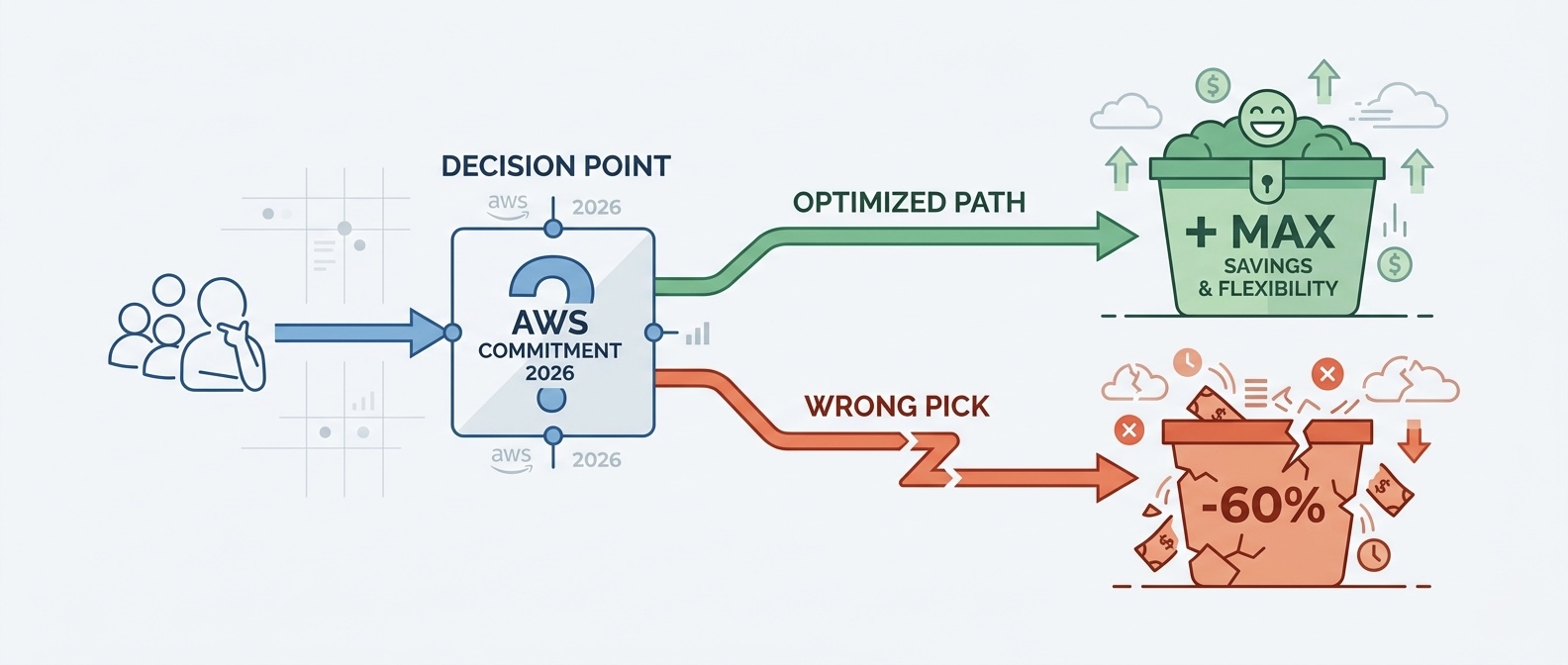
Stop comparing feature lists. Start comparing total cost of ownership for your specific workload profile. Here is the framework we use with every client:
Step 1: Profile Your Workloads
Categorize every workload into one of these types:
| Workload Type | Key Cost Driver | Provider That Usually Wins |
|---|---|---|
| Compute-heavy (APIs, web apps) | CPU/hour pricing | GCP (sustained use discounts) or Hetzner (raw performance) |
| Data-heavy (analytics, ML) | Storage + query pricing | GCP (BigQuery) or AWS (Redshift Serverless) |
| GPU/AI workloads | GPU instance availability and pricing | AWS (broadest selection) or GCP (TPUs for specific workloads) |
| Global edge delivery | Egress pricing + edge compute | Cloudflare (zero egress) |
| Enterprise integration | Ecosystem compatibility | Azure (Microsoft stack) |
| Simple web services | Total operational overhead | DigitalOcean/Railway (simplicity premium) |
Step 2: Model the Total Cost (Not Just Compute)
For each provider, calculate:
- Compute costs for your actual utilization pattern (not peak capacity)
- Storage costs by tier with realistic access patterns
- Data transfer costs between all services, regions, and external endpoints
- Managed service fees for databases, caches, queues, and monitoring
- Support plan costs at your expected spend level
- Engineering time cost for operating on each platform (this is the one everyone forgets)
Step 3: Run a 30-Day Proof of Concept
Do not commit to a 12-month modernization project based on spreadsheet estimates. Take your highest-priority workload, deploy it on your top two provider candidates, and run both for 30 days with real traffic.
Measure actual costs, actual performance, and actual operational overhead. The results will almost certainly surprise you, and they will save you from making a multi-year mistake.
Step 4: Negotiate Before You Commit
Every major cloud provider offers negotiated pricing for committed spend. If your annual cloud bill will exceed $100K, you should be talking to their sales team before making purchasing decisions. Discounts of 15% to 35% on top of published pricing are common for committed contracts.
But do not commit before you have run the proof of concept. Negotiated pricing with the wrong provider is still the wrong provider.
The 90-Day Cloud Infrastructure Modernization Playbook
Here is the execution timeline we follow with clients. Adjust the pace based on your team size and complexity, but do not skip steps.
Week 1-2: Discovery and Assessment
- Complete inventory of all current infrastructure, workloads, and dependencies
- Map data flows, integration points, and compliance requirements
- Calculate current total cost of ownership (including engineering time)
- Identify the highest-ROI modernization target
Week 3-4: Provider Selection and Architecture
- Run cost models for top 2-3 providers based on your workload profile
- Design target architecture for the first workload
- Define infrastructure as code templates
- Set up FinOps tagging and cost monitoring from day one
Week 5-8: Migration and Modernization
- Deploy target architecture in new environment
- Migrate first workload with zero-downtime cutover strategy
- Validate performance, security, and cost against projections
- Implement automated deployment pipelines
Week 9-10: Optimization and Expansion
- Right-size all resources based on actual utilization data
- Implement Reserved Instances or Savings Plans for predictable workloads
- Begin planning second workload migration
- Run first formal cost review
Week 11-12: Governance and Scaling
- Document operational procedures and runbooks
- Set up automated compliance and security checks
- Establish monthly FinOps review cadence with engineering and finance
- Create modernization roadmap for remaining workloads
Real-World Results: How an AI Company Cut Infrastructure Costs by 42% During Modernization
A Toronto-based AI startup was running on a mix of legacy on-premises servers and over-provisioned AWS instances. Monthly infrastructure spend was $67,000, and growing 15% quarter over quarter with no corresponding revenue growth.
Here is what their environment looked like before modernization:
- GPU training jobs running on on-demand p3.8xlarge instances 24/7 ($72/hour)
- PostgreSQL on a db.r5.4xlarge RDS instance at 12% average CPU utilization
- 15TB of training data stored entirely on S3 Standard
- Application services running on m5.2xlarge instances provisioned for peak load but averaging 8% utilization
- No resource tagging, no cost alerts, no FinOps practices
After a 10-week modernization engagement, here is what changed:
- GPU training moved to Spot Instances with checkpointing, reducing GPU costs by 65%
- PostgreSQL right-sized to db.r6g.2xlarge (Graviton) with auto-scaling read replicas, cutting database costs by 55%
- Training data moved to S3 Intelligent-Tiering with lifecycle policies, saving 40% on storage
- Application services containerized on EKS with Karpenter for right-sized, just-in-time node provisioning
- Comprehensive tagging, weekly cost reviews, and anomaly alerts implemented
Results:
- Monthly spend dropped from $67,000 to $38,800 (42% reduction)
- Annual savings: $338,400
- Deployment frequency increased from weekly to multiple times per day
- Mean time to recovery for incidents dropped from 4 hours to 22 minutes
The savings paid for the entire modernization engagement in the first 7 weeks.
Infrastructure Modernization Readiness Checklist
Use this to assess whether your organization is ready to modernize and whether you have covered the essentials:
| Category | Task | Status |
|---|---|---|
| Assessment | Complete inventory of all workloads and infrastructure | [ ] |
| Assessment | Map all data flows, dependencies, and integration points | [ ] |
| Assessment | Calculate current total cost of ownership | [ ] |
| Strategy | Define modernization goals with measurable KPIs | [ ] |
| Strategy | Run cost models for at least 2 cloud providers | [ ] |
| Strategy | Identify first modernization target (highest ROI, lowest risk) | [ ] |
| Execution | Set up infrastructure as code from day one | [ ] |
| Execution | Implement resource tagging and cost monitoring before migration | [ ] |
| Execution | Plan zero-downtime cutover with rollback procedures | [ ] |
| Optimization | Right-size all resources based on actual utilization | [ ] |
| Optimization | Purchase Reserved Instances or Savings Plans for predictable workloads | [ ] |
| Governance | Establish monthly FinOps review cadence | [ ] |
| Governance | Document operational procedures and runbooks | [ ] |
What to Do Next
If you are staring at a legacy infrastructure that is getting more expensive and harder to maintain every quarter, the cost of waiting is real. Every month you delay modernization is another month of paying the maintenance tax on systems that are holding your team back.
But rushing into a modernization without the right strategy is worse than waiting. Pick your provider based on data, not marketing. Modernize in phases, not all at once. And build cost awareness into every decision from the start.
If you want a team that has done this dozens of times to handle the heavy lifting, our Cloud Migration and Modernization service covers everything from assessment through execution. And our Cloud Cost Optimization and FinOps service ensures your new environment stays lean from day one.
Your infrastructure should be an accelerator, not an anchor. Let's make sure it is the right one.