"Best Cloud Storage 2026" Lists Will Cost You 40-70%
Open any "Top 10 Cloud Storage Providers 2026" article and you will find the same template: a ranked list of providers sorted by storage price per GB, with a few sentences about each one's "pros and cons." The implicit message is that there is one "best" storage provider you should pick.
There is not.
We migrated 2.3 petabytes of production data across six providers (AWS S3, Cloudflare R2, Backblaze B2, Wasabi, Google Cloud Storage, Azure Blob Storage) for clients in 2025-2026. The "right" provider for each migration was different. For one client, picking by sticker price would have cost an extra $84,000 per year. For another, sticking with their existing S3 deployment was the right answer because their actual egress was negligible and switching would have broken three integrations.
Most "best cloud storage" lists fail because they optimize for the variable that matters least: storage price per GB. The variables that actually determine your bill are egress volume, request count per GB, ecosystem dependencies, and access pattern predictability. This post gives you the decision framework based on real production migrations, not vendor marketing.
If you are about to pick a cloud storage provider in 2026, do not pick by ranked list. Pick by workload.
The Six Providers That Actually Matter in 2026
The cloud storage market has consolidated. There are six providers worth seriously evaluating for production object storage workloads. Here are their May 2026 prices for 1TB stored, plus 1TB monthly egress, in US regions.
| Provider | Storage ($/TB/mo) | Egress ($/TB) | PUT/GET ($/1M) | Min Retention | API |
|---|---|---|---|---|---|
| AWS S3 Standard | $23.00 | $90.00 | $5.00/$0.40 | None | S3 |
| AWS S3 IA | $12.50 | $90.00 | $10.00/$1.00 | 30 days | S3 |
| Cloudflare R2 | $15.00 | $0.00 | $4.50/$0.36 | None | S3-compatible |
| Backblaze B2 | $6.00 | $10.00 | $4.00/$0.40 | None* | S3-compatible |
| Wasabi | $6.99 | $0.00 | Free | 90 days | S3-compatible |
| Google Cloud Standard | $20.00 | $80.00 | $5.00/$0.40 | None | GCS |
| Azure Blob Hot | $20.80 | $87.00 | $5.50/$0.44 | None | Azure |
*Backblaze B2 free egress up to the size of stored data per month if served via Cloudflare CDN through Bandwidth Alliance.
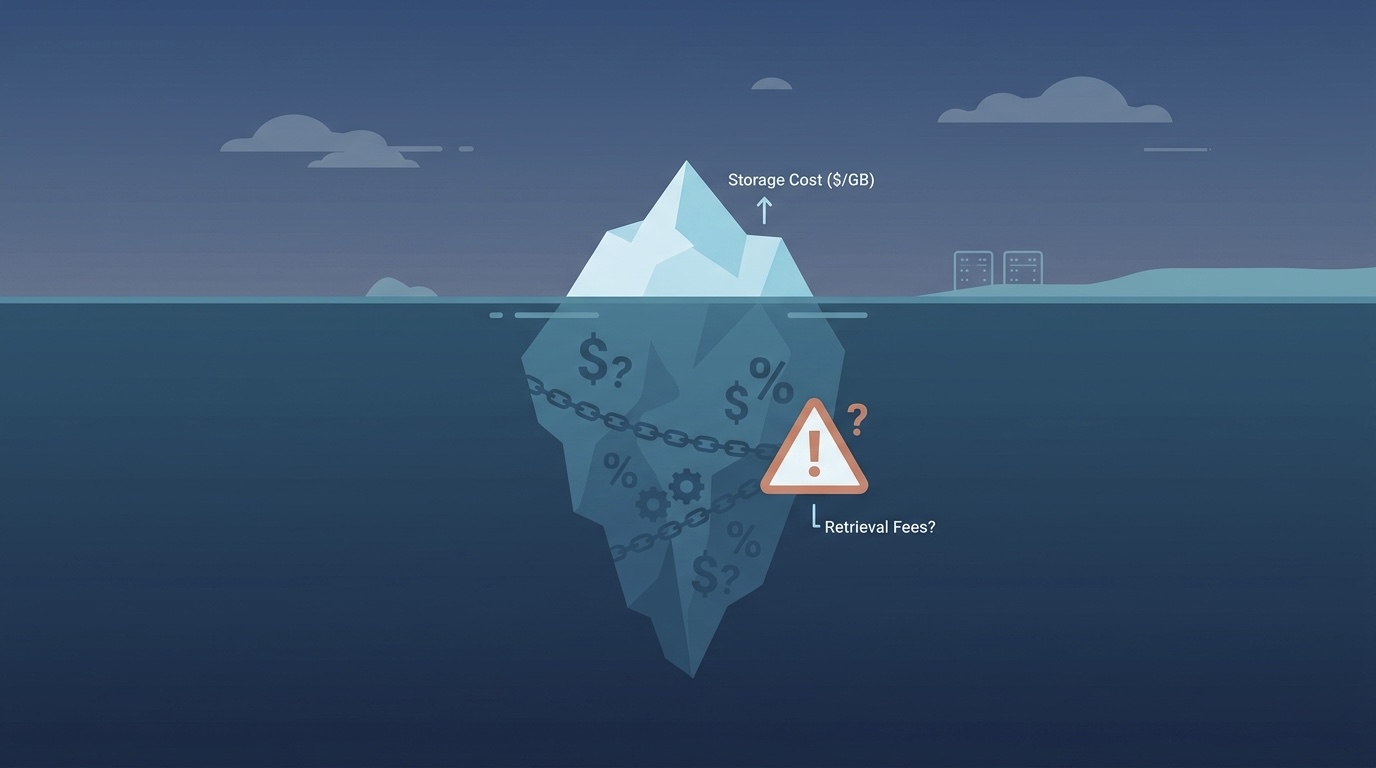
Storage price spread: $6 to $23 per TB. Egress price spread: $0 to $90 per TB. The egress spread is 9x larger than the storage spread. And yet "best cloud storage" lists almost universally rank by storage price.
The Four Variables That Actually Determine Your Bill
After 2.3PB of migrations, here are the variables that determine which provider wins for your workload, in priority order.
Variable 1: Monthly Egress Volume (The 800-Pound Gorilla)
Egress fees are the single biggest cost driver for most production storage workloads. AWS, Google, and Azure charge $80-90 per TB egressed to the public internet. R2 and Wasabi charge zero. Backblaze B2 charges $10/TB.
For a 100TB storage workload serving 50TB/month of egress:
- AWS S3: $2,300 storage + $4,500 egress = $6,800/month
- Cloudflare R2: $1,500 storage + $0 egress = $1,500/month
- Backblaze B2: $600 storage + $500 egress = $1,100/month
- Wasabi: $699 storage + $0 egress = $699/month (if eligible — see below)
S3 costs 9.7x more than Wasabi for the same workload. That gap is almost entirely egress fees.
Variable 2: Request Volume (The Hidden Cost)
S3, GCS, and Azure charge $4-5.50 per million PUT/POST requests and $0.40-0.44 per million GET requests. For workloads with many small objects (analytics chunks, image thumbnails, log fragments), request fees can rival or exceed storage fees.
For a workload doing 100 million PUTs and 1 billion GETs per month:
- AWS S3: $500 PUT + $400 GET = $900/month in request fees alone
- Wasabi: $0 (free requests) = $0/month
- R2: $450 PUT + $360 GET = $810/month
- Backblaze B2: $400 PUT + $400 GET = $800/month
Wasabi's free request pricing is the killer feature for analytics and IoT workloads with high object counts. Most "best of" lists do not even mention this.
Variable 3: Ecosystem Dependencies (The Lock-In Tax)
If your application stack runs on AWS, S3 is often the right choice despite higher prices because:
- Athena, Redshift Spectrum, EMR, Glue, and Lake Formation only natively integrate with S3
- IAM-based access from EC2/Lambda/ECS is seamless and free (no cross-cloud auth complexity)
- VPC endpoints eliminate data transfer fees for AWS-internal traffic
- CloudTrail, Config, Macie, and other compliance tools assume S3
Switching from S3 to R2 to save $5,000/month is a bad trade if it breaks your data lake querying or requires building cross-cloud auth infrastructure. Total cost of ownership includes engineering time and operational risk.
The lock-in tax is real but quantifiable: estimate 200-400 engineering hours to migrate an established AWS data lake away from S3, plus ongoing operational complexity.
Variable 4: Access Pattern Predictability (The Tier Trap)
If your access pattern is predictable (e.g., logs older than 30 days are rarely accessed), lifecycle rules to cheaper tiers (S3 IA, S3 Glacier, GCS Coldline, Azure Cool) can dramatically reduce cost without switching providers.
If your access pattern is unpredictable, you have two choices:
- Pay for the highest-access tier on every object (wasteful)
- Use auto-tiering features like S3 Intelligent-Tiering (which charges per-object monitoring fees that often exceed savings — see our detailed analysis)
Providers like Wasabi and B2 do not have a tiering concept — pricing is uniform regardless of access frequency. This is actually an advantage for unpredictable workloads.
The Workload-to-Provider Decision Matrix
Match your workload to the right provider using this matrix. We built this from actual migration outcomes, not theoretical comparisons.
| Workload Type | Best Provider | Why | Typical Savings vs S3 |
|---|---|---|---|
| Public website assets, downloads, media | Cloudflare R2 | Zero egress, fast global CDN | 70-90% |
| Application log archive (write-heavy, low-read) | Backblaze B2 | Cheap storage, low PUT cost | 60-75% |
| Compliance/legal hold archive (rarely accessed) | Wasabi | Cheap storage, free egress, 90-day retention OK | 65-80% |
| Data lake / analytics on AWS | AWS S3 | Athena/Glue/EMR native integration | 0% (S3 is right) |
| Backup target (daily, periodic restore) | Backblaze B2 | Cheap, S3-compatible, well-supported by backup tools | 60-75% |
| User-uploaded content for SaaS app | Cloudflare R2 | Zero egress, simple S3-compatible API | 70-85% |
| ML training dataset (read-heavy, regenerable) | R2 or B2 | Egress free or cheap, no premium needed | 65-90% |
| Scientific/genomic data (egress to compute) | R2 or in-region S3 | Match storage to compute location | Variable |
| Multi-region replicated production data | AWS S3 | Cross-region replication is mature; alternatives are weaker | 0% (S3 is right) |
| Static site assets behind a CDN | R2 or B2 with Cloudflare | Free or near-free egress | 80-95% |
| Database backups | Wasabi or B2 | Cheap, predictable retention | 60-80% |
| User profile pictures / thumbnails (many small objects) | Wasabi | Free PUT/GET requests | 70-85% |
| Snowflake/Databricks external table source | AWS S3 or GCS | Native integrations | 0% (cloud DW dictates) |
| Container image registry storage | Provider-native (ECR, GCR, ACR) | Pricing optimized for image layers | N/A |
| Disaster recovery archive | Wasabi or B2 | Cheap storage, retention pricing OK | 65-80% |
Real-World Cost Modeling: Three Production Workloads
We modeled three real workload profiles across all six providers. Numbers are May 2026 pricing.
Workload A: SaaS App User Uploads (Egress-Heavy)
- 50TB stored, growing 5TB/month
- 30TB/month outbound egress (users downloading their files)
- 20M PUTs, 200M GETs per month
| Provider | Monthly Cost | Annual Cost |
|---|---|---|
| AWS S3 Standard | $1,150 + $2,700 + $180 = $4,030 | $48,360 |
| Google Cloud Standard | $1,000 + $2,400 + $180 = $3,580 | $42,960 |
| Azure Blob Hot | $1,040 + $2,610 + $200 = $3,850 | $46,200 |
| Cloudflare R2 | $750 + $0 + $162 = $912 | $10,944 |
| Backblaze B2 | $300 + $300 + $160 = $760 | $9,120 |
| Wasabi | $349 + $0 + $0 = $349 | $4,188 |
Verdict: Wasabi wins on cost ($349/mo) but B2 ($760/mo) is more flexible. R2 ($912/mo) wins for global content delivery. AWS S3 ($4,030/mo) is 11.5x more expensive than Wasabi for the same workload.
Workload B: Data Lake on AWS (Low Egress, AWS-Integrated)
- 200TB stored, growing 20TB/month
- 1TB/month egress (mostly internal AWS traffic, free via VPC endpoint)
- 5M PUTs, 50M GETs per month
- Queried by Athena, EMR, and Lake Formation
| Provider | Monthly Cost | Notes |
|---|---|---|
| AWS S3 Standard | $4,600 + $0 (VPC) + $45 = $4,645 | Native Athena, Glue, EMR |
| AWS S3 IA (mixed) | $2,500 + $0 + $90 = $2,590 | Lifecycle to IA at 30 days |
| Cloudflare R2 | $3,000 + $0 + $40 = $3,040 | Loses Athena native, requires custom integrations |
| Backblaze B2 | $1,200 + $10 + $40 = $1,250 | Loses Athena, EMR integrations |
| Wasabi | $1,398 + $0 + $0 = $1,398 | Loses entire AWS analytics stack |
Verdict: AWS S3 (with IA lifecycle for $2,590/mo) is the right choice despite alternatives looking cheaper. Migrating off S3 would cost more than $1,500/mo in lost engineering time and broken integrations. This is when S3's "high price" is actually the cost-optimal answer.
Workload C: Compliance Archive (Cold, Rarely Accessed)
- 500TB stored, growing 10TB/month
- 0.1TB/month egress (rare audit retrieval)
- 100K PUTs, 1M GETs per month
- Must retain 7 years for regulatory compliance
| Provider | Monthly Cost | Annual Cost |
|---|---|---|
| AWS S3 Standard | $11,500 + $9 + $1 = $11,510 | $138,120 |
| AWS S3 Glacier Deep Archive | $495 + $9 + $5 = $509 | $6,108 |
| Cloudflare R2 | $7,500 + $0 + $1 = $7,501 | $90,012 |
| Backblaze B2 | $3,000 + $1 + $1 = $3,002 | $36,024 |
| Wasabi | $3,495 + $0 + $0 = $3,495 | $41,940 |
Verdict: S3 Glacier Deep Archive ($509/mo) is unbeatable for true cold storage if retrieval can wait 12 hours. For warmer archives needing instant access, Backblaze B2 ($3,002/mo) wins. S3 Standard ($11,510/mo) is wildly wrong for this workload — most teams realize this only after the bill hits annual review.
The Egress Math That Determines Everything
The single most important calculation when picking storage in 2026 is your egress ratio: monthly outbound TB divided by total stored TB. This number tells you whether to optimize for storage price (low egress) or egress price (high egress).
| Egress Ratio | Best Provider Class |
|---|---|
| Under 5% | Cheap storage providers (B2, Wasabi) |
| 5-25% | R2 (zero egress) or B2 (cheap egress) |
| 25-100% | R2 dominates (storage premium offset by zero egress) |
| Over 100% | R2 is the only sane choice |
Example: A storage-heavy archive with 1PB stored and 1TB egress/month has an egress ratio of 0.1% — go cheapest storage (B2 or Wasabi). A media SaaS with 10TB stored and 100TB egress/month has an egress ratio of 1000% — go R2 (the storage premium is irrelevant compared to egress savings).
Most teams have never calculated their egress ratio. Yet it determines 60-80% of their bill.
When AWS S3 Is Still the Right Choice
To be clear: S3 is not dead. We have several clients on S3 where it is the cost-optimal answer. S3 wins when:
- Your data lake is on AWS (Athena, Glue, EMR, Redshift Spectrum, Lake Formation)
- Your compute is on AWS and you can route via VPC endpoint (free egress)
- You need mature cross-region replication for compliance/availability
- You have established compliance audits specific to S3 and migration would trigger re-audit
- Your engineering team is unfamiliar with S3-compatible alternatives and migration risk exceeds savings
- Your workload generates negligible egress (e.g., everything stays inside AWS)
- You use S3 Object Lambda, S3 Select, S3 Access Points, or other S3-specific features
For about 30% of the workloads we audit, S3 remains the right choice. For the other 70%, an alternative provider would save 40-80% with acceptable migration risk.
Hidden Costs Most Comparisons Miss
Hidden Cost 1: Cross-Cloud Egress to Reach Compute
If your storage is on R2 but your compute is on AWS, every read pulls data across clouds. R2's free egress is between R2 and the public internet — but AWS still charges for ingress to its services (often $0). The bigger issue: latency and cross-cloud auth complexity.
Mitigation: Place storage and compute in the same provider when possible, or use providers with peering (Cloudflare's Bandwidth Alliance).
Hidden Cost 2: API Compatibility "Mostly"
Most "S3-compatible" providers support 90-95% of the S3 API. The 5-10% of unsupported features include obscure but sometimes-critical things:
- S3 Object Lambda (transformations on read)
- Conditional writes with specific ETag semantics
- S3 Select (server-side query)
- Some replication topologies
- Vendor-specific permissions models
Test your application's actual S3 calls against the alternative API before migration. Use a tool like mc or s3cmd to validate operations work as expected.
Hidden Cost 3: Minimum Retention and Early Deletion Fees
- Wasabi: 90-day minimum retention. Delete after 30 days, pay for 90.
- AWS S3 IA: 30-day minimum, plus 128KB minimum object size billing.
- AWS S3 Glacier Deep Archive: 180-day minimum.
- Backblaze B2: No minimum on storage, but 90-day minimum on Bandwidth Alliance free egress.
For workloads with high object churn (frequent overwrites/deletions), these minimums can completely negate the storage price advantage. Calculate your true cost including expected deletion patterns.
Hidden Cost 4: Bandwidth Alliance and CDN Routing
Backblaze B2's free egress is only when traffic exits through Cloudflare CDN under the Bandwidth Alliance. Direct egress from B2 still costs $10/TB. For B2 to be truly free-egress, you must serve through a Bandwidth Alliance partner CDN, which adds a tiny operational layer (CDN configuration, cache invalidation rules).
Hidden Cost 5: Storage Lifecycle Re-Tiering Costs
Moving data between tiers incurs lifecycle transition fees. AWS charges $0.01 per 1,000 lifecycle transitions. For a bucket with 100M objects transitioning to IA, that is a one-time $1,000 fee on top of ongoing storage costs. For Glacier, transition costs go up.
A Migration Decision Framework: 5 Questions
Before migrating any workload off S3 (or any provider), answer these questions in order:
Question 1: What is your egress ratio?
Calculate (monthly egress TB) / (stored TB). If under 5%, storage price dominates; pick the cheapest. If over 25%, egress price dominates; pick a zero-egress provider.
Question 2: What integrations are you using?
List every service that touches your storage: data lake tools (Athena, Glue, BigQuery), backup tools (Veeam, Commvault), CDN (CloudFront, Cloudflare), ML frameworks (SageMaker, Vertex AI). Check that the alternative supports all of them. If not, factor in integration rebuild cost.
Question 3: What is your compliance posture?
If you have audit obligations (SOC 2, HIPAA, FedRAMP, ISO 27001) that reference your specific provider, switching may trigger a costly re-audit. Get audit team buy-in before scoping migration.
Question 4: What is the migration cost?
Estimate engineering hours, data transfer fees (if migrating from a provider that charges egress), and operational risk during cutover. A 100TB migration off S3 with $90/TB egress is $9,000 just to move the data, plus 200-400 engineer hours.
Question 5: What is your annual savings?
If annual savings exceed migration cost by 3x within 12 months, migrate. If less, stay on current provider and optimize within it (lifecycle rules, storage class transitions, request batching).
The 30-Day Storage Cost Audit
Run this audit on every storage workload over $1,000/month. We typically find 30-60% savings opportunities.
Week 1: Visibility
- Enable cost allocation tags on every bucket
- Pull your last 3 months of storage bills, broken down by bucket
- Calculate egress ratio per bucket: outbound TB / stored TB
- List which services touch each bucket (CloudTrail/equivalent)
Week 2: Categorize Workloads
Map each bucket to one of these categories:
- High-egress public content (R2 candidate)
- Cold archive (Glacier Deep Archive or B2 candidate)
- Hot data lake on AWS (S3 with lifecycle to IA)
- Backup target (B2 or Wasabi candidate)
- Mixed workload (needs further analysis)
Week 3: Model Costs
For each workload not currently on the cost-optimal provider, calculate:
- Current monthly cost (last 90 days average)
- Projected cost on alternative provider
- Migration cost (data transfer + engineering hours)
- Break-even timeline
Week 4: Execute Quick Wins
- Apply lifecycle rules to any bucket with predictable cold data (immediate savings)
- Enable VPC endpoints to eliminate AWS-internal egress fees (immediate savings)
- Migrate workloads where break-even is under 6 months
- Defer migrations where break-even is over 12 months (likely not worth the risk)
The Bottom Line
There is no single "best cloud storage 2026." Anyone telling you to use one provider for all workloads is selling you something. The right answer depends on your egress ratio, your ecosystem dependencies, your access patterns, and your migration appetite.
The cost-optimal default in 2026 for most new workloads: Cloudflare R2 if you have any egress at all, Backblaze B2 if you do not, AWS S3 only if you have specific AWS ecosystem requirements that make alternatives painful.
If you are running a storage workload over $5,000/month and have not run this analysis in the last 12 months, you are almost certainly overpaying. Our cloud cost optimization team runs free storage audits and typically finds 40-70% savings within the first migration. Run a free Cloud Waste Scorecard to identify your biggest storage cost leaks first.
Further reading:
- Cloudflare R2 vs AWS S3 Decision Framework 2026
- S3 Intelligent-Tiering vs Standard Hidden Costs
- Cloud Cost Optimization Storage Strategies 2026
- Cheapest Cloud Object Storage 1TB-2TB Comparison 2026
- Enterprise Cloud Storage 500TB TCO Comparison 2026
- Cloud Cost Optimization FinOps Service
- AWS S3 Pricing Documentation
- Cloudflare R2 Pricing